New construction in Johnson County and Jackson County is held to stricter energy codes than most builders expect, and the blower door test at final inspection is the moment those requirements become real. Pre-drywall air sealing in Kansas City is the step that determines whether a home passes that test the first time or fails and triggers a costly re-inspection cycle. For custom homebuilders and production contractors working in the KC metro, understanding what inspectors are looking for — and how to meet the standard reliably — is the difference between a clean closeout and a project that bleeds time and margin at the finish line.
Why Pre-Drywall Air Sealing Is Not Optional in Kansas City
Kansas residential construction is governed by the International Energy Conservation Code (IECC), which Kansas has adopted with local amendments. The current adopted version in Johnson County and Jackson County requires new homes to meet a maximum air leakage rate measured by a blower door test at final inspection.
The target is 3 ACH50 or lower for most residential construction — meaning the home can exchange no more than three times its total air volume per hour when pressurized to 50 Pascals. Homes that test above that threshold fail and cannot receive a certificate of occupancy until they meet the standard.
Here is why that matters for timing: once drywall is installed, the penetration points that drive most air leakage are sealed behind finished walls. Correcting them after drywall means cutting into finished surfaces, sealing behind them, patching, retexturing, repainting, and re-inspecting. That process can cost $3,000 to $8,000 depending on how many locations are involved and the extent of finished work already completed.
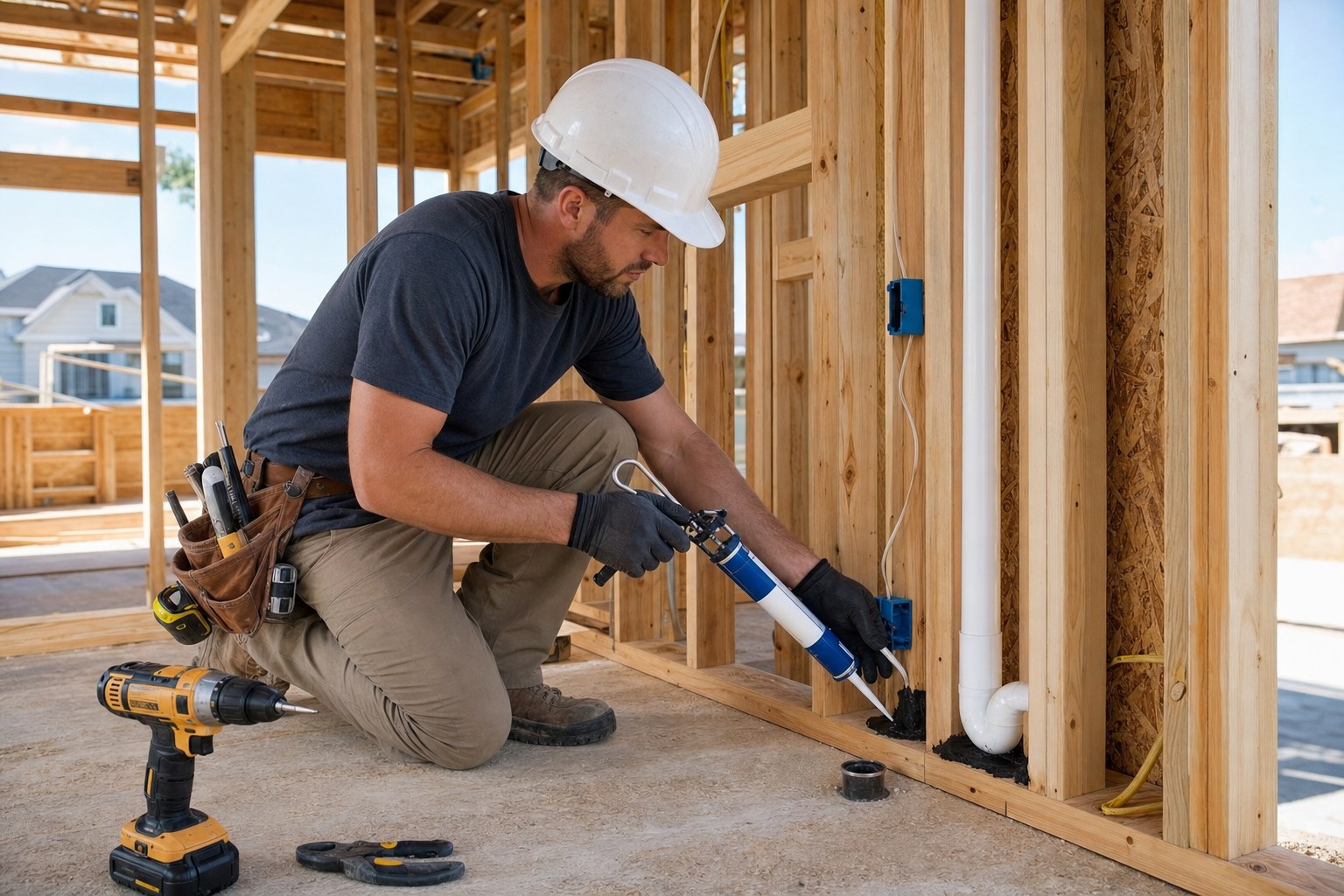
Pre-drywall sealing addresses those same penetration points before any finished material is in place — at a fraction of the cost and with far less disruption. For builders in Overland Park, Olathe, and Lee’s Summit where new construction activity is high, this is a standard part of a well-managed energy compliance workflow.
What Inspectors Look For During Blower Door Testing
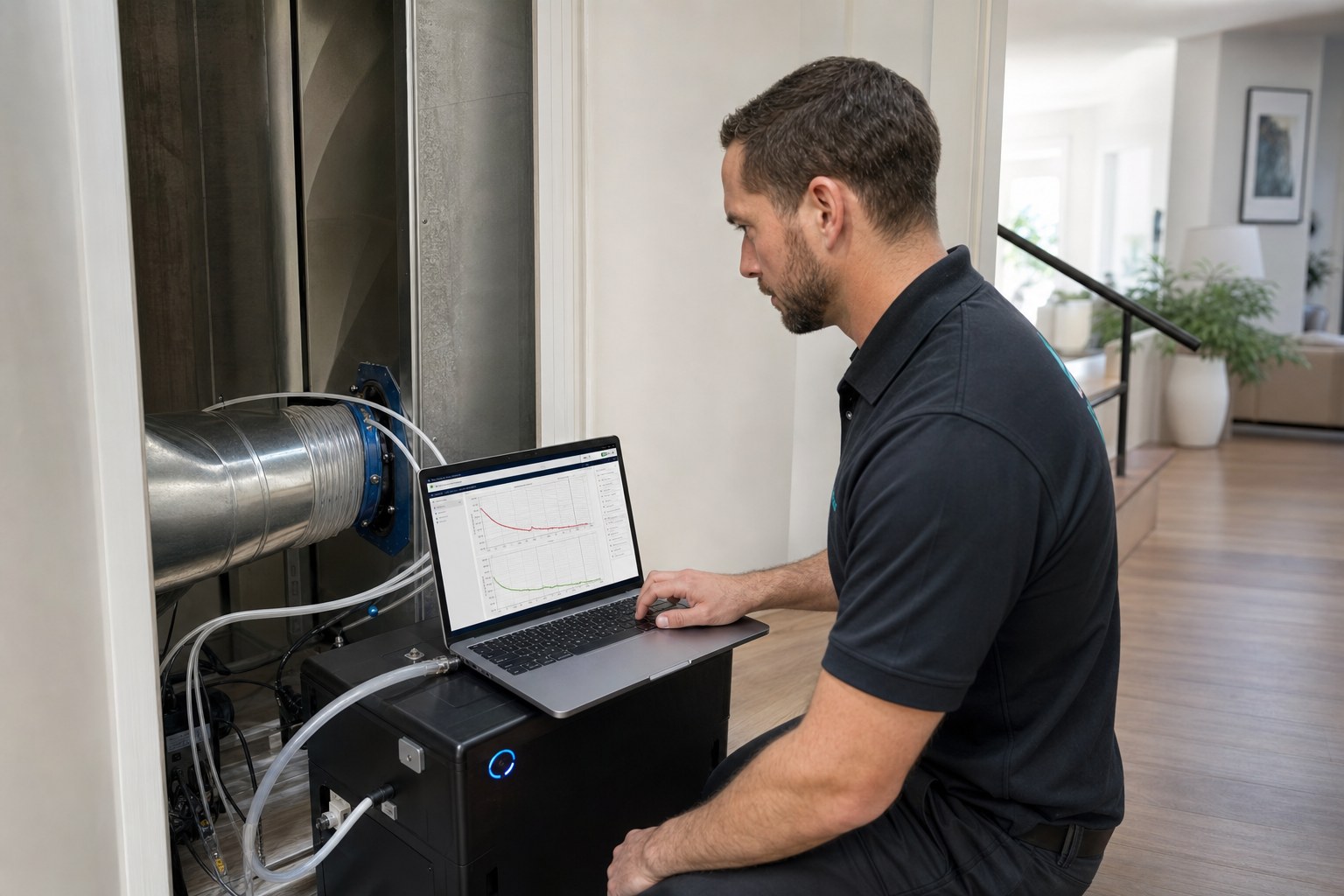
A blower door test measures the home as a system — it doesn’t evaluate individual penetrations separately. The inspector installs the blower door unit in a doorframe, depressurizes the home to 50 Pascals, and measures total airflow required to maintain that pressure. The result is expressed as CFM50 (cubic feet per minute at 50 Pascals) and converted to ACH50 based on conditioned floor area and ceiling height.
While the test itself is a single number, experienced inspectors often use smoke pencils or thermal imaging during depressurization to identify the specific locations where air is entering. The areas that most commonly drive failures in Kansas City new construction include:
- Top plates at the ceiling-wall intersection, particularly at interior wall corners
- Rim joist areas at the foundation perimeter
- Plumbing penetrations through top and bottom plates
- Electrical penetrations, recessed light housings, and electrical box backs
- HVAC duct penetrations through floor and ceiling assemblies
- Attic hatch perimeters
- Fireplace framing and chase construction
- Garage-to-living-space wall and ceiling penetrations
According to the U.S. Department of Energy’s building envelope guidance, these categories account for the majority of air leakage in new residential construction. Each individual penetration may seem small, but they accumulate across a full floor plate into meaningful total leakage.
The Cost of Failing a Blower Door Test After Drywall
Builders who skip pre-drywall sealing or underestimate the current code requirements often discover the problem during final inspection. The financial impact is not just the cost of remediation — it’s the compounding effect of a delayed certificate of occupancy.
Consider a typical scenario on a custom home in Overland Park:
- Blower door test fails at 4.8 ACH50 against a 3.0 ACH50 requirement
- Inspector identifies multiple failure areas requiring remediation
- Drywaller and painter return to cut access, seal penetrations, patch, and refinish: $4,000 to $6,000
- Re-inspection fee and scheduling delay: 1 to 2 weeks
- Carrying costs on the completed home during delay: varies by loan structure but often $1,500 to $3,000 per week for a custom home in this price range
- Potential buyer satisfaction impact if closing is delayed
The total cost of a post-drywall failure typically ranges from $6,000 to $15,000 when remediation, re-inspection, and carrying costs are combined. Pre-drywall sealing done right before drywall installation costs a fraction of that and eliminates the risk entirely.
How AeroBarrier Solves the Problem in One Session
Manual pre-drywall air sealing — caulk guns, spray foam, and hand-applied sealants at every penetration — works when done thoroughly. The challenge is consistency. A framing crew working across hundreds of penetration points will miss some. A crew working under schedule pressure will miss more. And there’s no way to verify the result until the blower door test, which by then may be after drywall.
Our AeroBarrier envelope air sealing service takes a different approach. AeroBarrier is an aerosol-applied sealant system developed by the same team behind Aeroseal duct sealing. The process works as follows:
- All intentional openings (windows, doors, HVAC registers) are temporarily covered with plastic sheeting
- The home is pressurized using blower door equipment to a consistent pressure level
- AeroBarrier sealant is atomized and distributed throughout the interior air
- The pressurized airstream carries sealant particles toward and into every gap, crack, and penetration where air is escaping
- Particles accumulate at leak edges and bond to form a continuous seal
- A real-time display shows the ACH50 reading dropping as sealing progresses
- The process stops when the target ACH50 is reached — typically well below the 3.0 code requirement
The result is a verified, documented air sealing result achieved in three to five hours on a typical Kansas City home, with a computer-generated report showing start and end leakage values. That report goes directly to the inspector. There is no guessing about whether the home will pass.
For builders managing multiple active projects in Johnson County and Jackson County, this process eliminates the inspection uncertainty that disrupts closeout schedules.
What Builders in the Kansas City Metro Need to Know
Several practical questions come up consistently when Kansas City builders evaluate pre-drywall air sealing for the first time:
When in the construction sequence should AeroBarrier be scheduled? After framing, rough mechanical, electrical, and plumbing are complete — and before drywall installation. All penetrations should be made and all intentional openings (window units, door units) should be in place. This is typically two to three weeks before drywall starts.
Does the process interfere with other trades? The sealing session takes three to five hours. Plastic sheeting is removed the same day. No curing time is required before other trades re-enter. It fits into a normal construction schedule without adding a separate mobilization day.
What ACH50 target should builders aim for? The Johnson County and Jackson County requirement is 3.0 ACH50. We recommend targeting 2.0 to 2.5 ACH50 during AeroBarrier to provide margin against the code limit and to improve long-term home performance. Buyers increasingly ask about energy ratings, and a tight envelope is a marketable feature.
What about our new construction air sealing projects that already include manual sealing? AeroBarrier is an excellent supplement or replacement for manual sealing. Even on projects where crews have applied caulk and foam at accessible locations, AeroBarrier catches the penetrations that were missed and brings the final result to a verified level.
Frequently Asked Questions About Pre-Drywall Air Sealing in Kansas City
Is pre-drywall air sealing required by code in Johnson County?
The code requirement is for the final blower door test result — 3.0 ACH50 or lower. There is no code requirement specifying that sealing must happen pre-drywall. However, achieving the 3.0 ACH50 target without pre-drywall sealing is difficult on most homes, and correcting failures after drywall is significantly more expensive. Pre-drywall sealing is the practical strategy for meeting a post-drywall requirement at the lowest cost.
How much does pre-drywall air sealing cost in Kansas City?
AeroBarrier pricing for a Kansas City single-family home typically ranges from $1,500 to $3,500 depending on conditioned floor area and the target ACH50. Smaller production homes at the lower end of that range, larger custom homes toward the upper end. Manual pre-drywall sealing by crew with caulk and foam is less expensive but less reliable and not self-verifying. Call Green Seal Energy at (816) 200-0129 for a quote specific to your project and schedule.
What happens if my home fails the blower door test after drywall?
You’ll need to identify the specific leak locations — typically using a blower door in combination with smoke pencils or thermal imaging — and remediate them before re-inspection. In a finished home, that means cutting into walls or ceilings at failure points, sealing behind them, and refinishing the affected surfaces. Costs typically run $4,000 to $8,000 for remediation alone, plus re-inspection fees and any carrying costs during the delay. It’s a scenario worth a few thousand dollars in prevention to avoid.
Can AeroBarrier be used on renovations or additions, not just new construction?
Yes. AeroBarrier can be applied in existing homes before drywall during major renovations, room additions, or gut-rehab projects. The same process applies: rough mechanicals in, intentional openings covered, pressurize and seal, verify result. For Kansas City homeowners doing significant renovation work, it’s an option to discuss with your contractor and with Green Seal Energy during the planning phase.
Talk to Green Seal Energy Before Your Next Project Drywalls
Green Seal Energy works with custom home builders, production contractors, and renovation teams across Overland Park, Olathe, Lee’s Summit, and the broader Kansas City metro. Scheduling a pre-drywall AeroBarrier session before your next project moves to drywall takes one phone call and eliminates the most expensive inspection risk in new residential construction. Call us at (816) 200-0129 or schedule online to discuss your project timeline and get a quote.