If you build homes in the Kansas City area, new construction air sealing is one of the most important steps you can take before drywall goes up. Once the sheathing is covered, correcting air leakage becomes expensive, time-consuming, and in many cases impossible without tearing into finished walls. Builders in Johnson County and Jackson County are now facing stricter code requirements under the 2021 IRC energy provisions, with 2026 enforcement dates approaching fast. Getting air sealing right the first time protects your HERS rating, keeps your buyers happy, and keeps your project on schedule. Green Seal Energy works with Kansas City builders to deliver measurable results at the pre-drywall stage using AeroBarrier, the only pressurized spray-applied air barrier that seals an entire envelope in a matter of hours.
The Pre-Drywall Window: Why Timing Matters
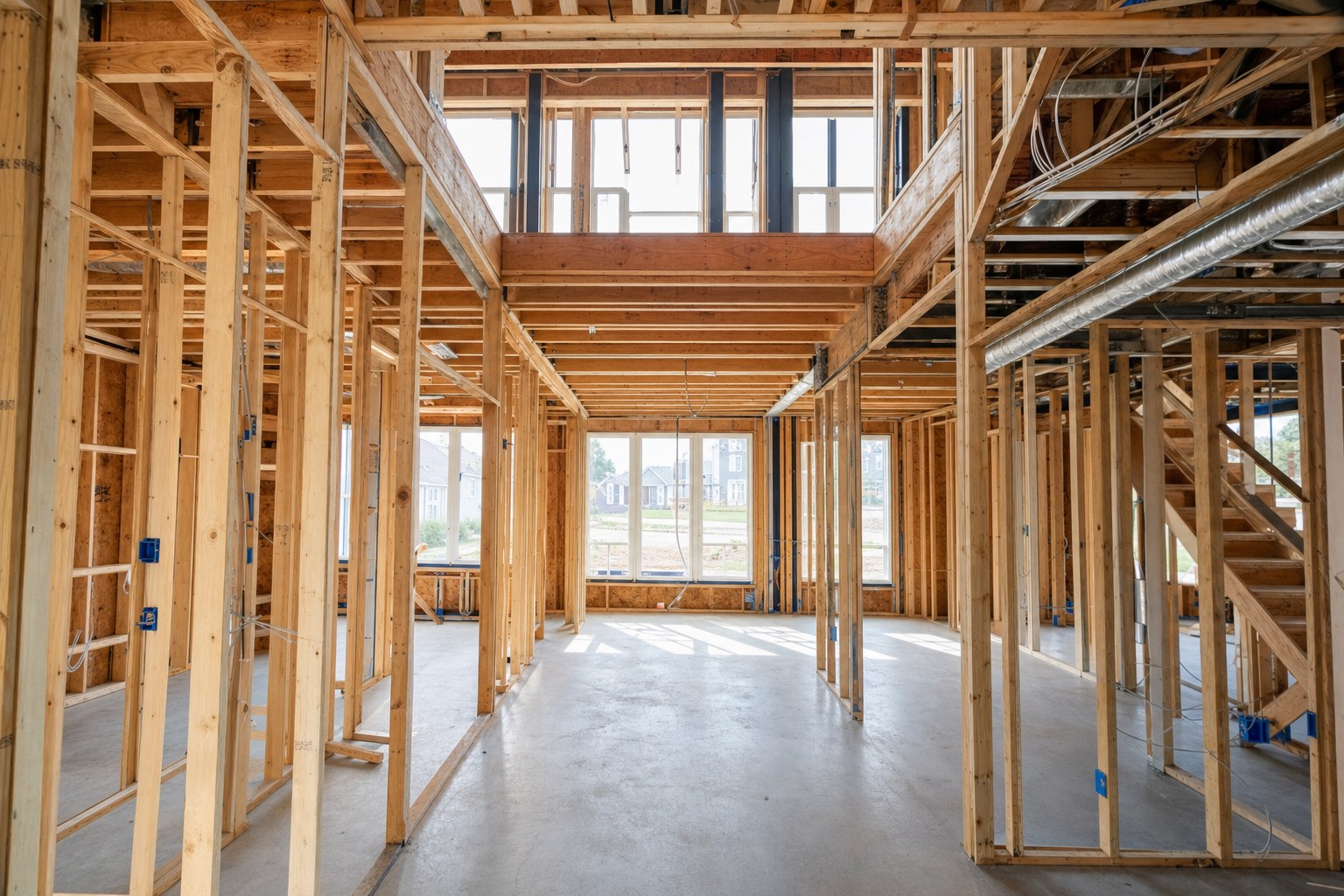
There is a narrow window in every new construction project when air sealing is both effective and affordable. That window opens after mechanical rough-in and closes when drywall is hung. During this stage, every penetration, gap, and seam in the building envelope is visible and accessible.
Traditional air sealing methods at this stage include caulk, spray foam, and weatherstripping applied by hand to each individual penetration. A thorough manual seal on a 2,500-square-foot home can take two to three days of labor. Even careful manual work often misses gaps hidden inside wall cavities, around wiring chases, or at rim joist intersections. Those missed gaps show up as blower door test failures later in the project when there is far less you can do about them.
AeroBarrier works differently. The process pressurizes the home and atomizes a water-based sealant into the air stream. The sealant particles travel to wherever air is escaping and build up at leak sites until the gap is sealed. The process is monitored in real time, so you know exactly when you have reached your target leakage rate. For Kansas City builders, this means a predictable result at the pre-drywall stage rather than a guessing game at final inspection.
HERS Rating Requirements and the 2021 IRC in Kansas City
The Home Energy Rating System (HERS) index measures a home’s energy efficiency against a reference home of the same size. A HERS score of 100 represents the reference home built to 2006 IECC standards. A score of 70 means the home uses 30 percent less energy than that baseline.
Under the 2021 IRC, which Kansas City jurisdictions are adopting on a rolling basis leading up to 2026 enforcement, new residential construction in Climate Zone 4 (which covers the Kansas City metro) must meet an air leakage limit of 3.0 ACH50 or less. That means no more than 3 air changes per hour when the home is pressurized to 50 pascals. Some jurisdictions and energy incentive programs push that requirement to 2.0 ACH50 or tighter.
Meeting 3.0 ACH50 with manual sealing is achievable but not guaranteed. Missing the target means scheduling a remediation crew, which adds cost and delays the certificate of occupancy. Missing the target on a home already committed to ENERGY STAR or DOE Zero Energy Ready certification can disqualify the entire project from its incentives. ENERGY STAR’s air sealing guidelines outline exactly where the critical leakage points occur in new construction.
Green Seal Energy’s AeroBarrier process can consistently hit 2.0 ACH50 or better, and the results are documented in real time with a printed certificate. For Johnson County builders filing for permits or participating in utility rebate programs, that documentation matters.
AeroBarrier vs. Manual Sealing: A Practical Comparison for Kansas City Contractors
Builders sometimes ask whether AeroBarrier is worth the cost compared to a thorough manual seal. Here is a straightforward breakdown.
Manual sealing typically costs between $800 and $2,000 per home depending on size, complexity, and labor rates in the Kansas City market. Results vary by crew skill level and are difficult to verify before drywall is installed. A blower door test after drywall is the only way to confirm performance, and by then your options for repair are limited.
AeroBarrier typically costs between $1,200 and $2,500 for a single-family home. The result is verified in real time before the crew leaves, and the process consistently outperforms manual methods on leakage rates. The cost premium over manual sealing is often offset by reduced callbacks, avoided rework after failed blower door tests, and faster project timelines.
For production builders in Olathe, Shawnee, and Lee’s Summit running multiple starts per month, the predictability of AeroBarrier translates directly into schedule reliability. You know what you will get before your inspector shows up.
Learn more about our AeroBarrier envelope air sealing process and how it fits into a new construction schedule.
Johnson County and Jackson County Code Enforcement: What Builders Need to Know for 2026
Johnson County, Kansas and Jackson County, Missouri are the two largest population centers in the Kansas City metro. Both are in the process of updating their residential building codes to align with the 2021 IRC energy provisions.
Johnson County has already adopted updated energy codes for new construction, with full enforcement including third-party HERS verification required for homes pursuing energy program certifications. Inspectors in Overland Park and Olathe are increasingly familiar with blower door testing requirements and will flag projects that cannot produce acceptable test results.
Jackson County jurisdictions, including Lee’s Summit and Blue Springs, are on a similar adoption timeline. Builders operating on the Missouri side of the metro should expect full 2021 IRC energy code enforcement to be in effect or imminent by 2026. Projects already in planning for 2025 and 2026 completions should be designed with a 3.0 ACH50 target as a minimum, with 2.0 ACH50 as the recommended target for any home entering an energy efficiency program.
Green Seal Energy monitors code changes across the Kansas City metro and can help builders understand the specific requirements for each jurisdiction. Call (816) 200-0129 to discuss your project before the foundation is poured.
What the AeroBarrier Process Looks Like on a Job Site
Builders who have not used AeroBarrier before often have questions about site logistics. Here is what a typical installation looks like on a Kansas City new construction project.
The process requires the home to be at roughly 50 percent humidity for the sealant to cure properly. Our crew arrives with a portable humidity control unit if site conditions require it. All HVAC equipment registers and openings are temporarily masked to protect them during the application.
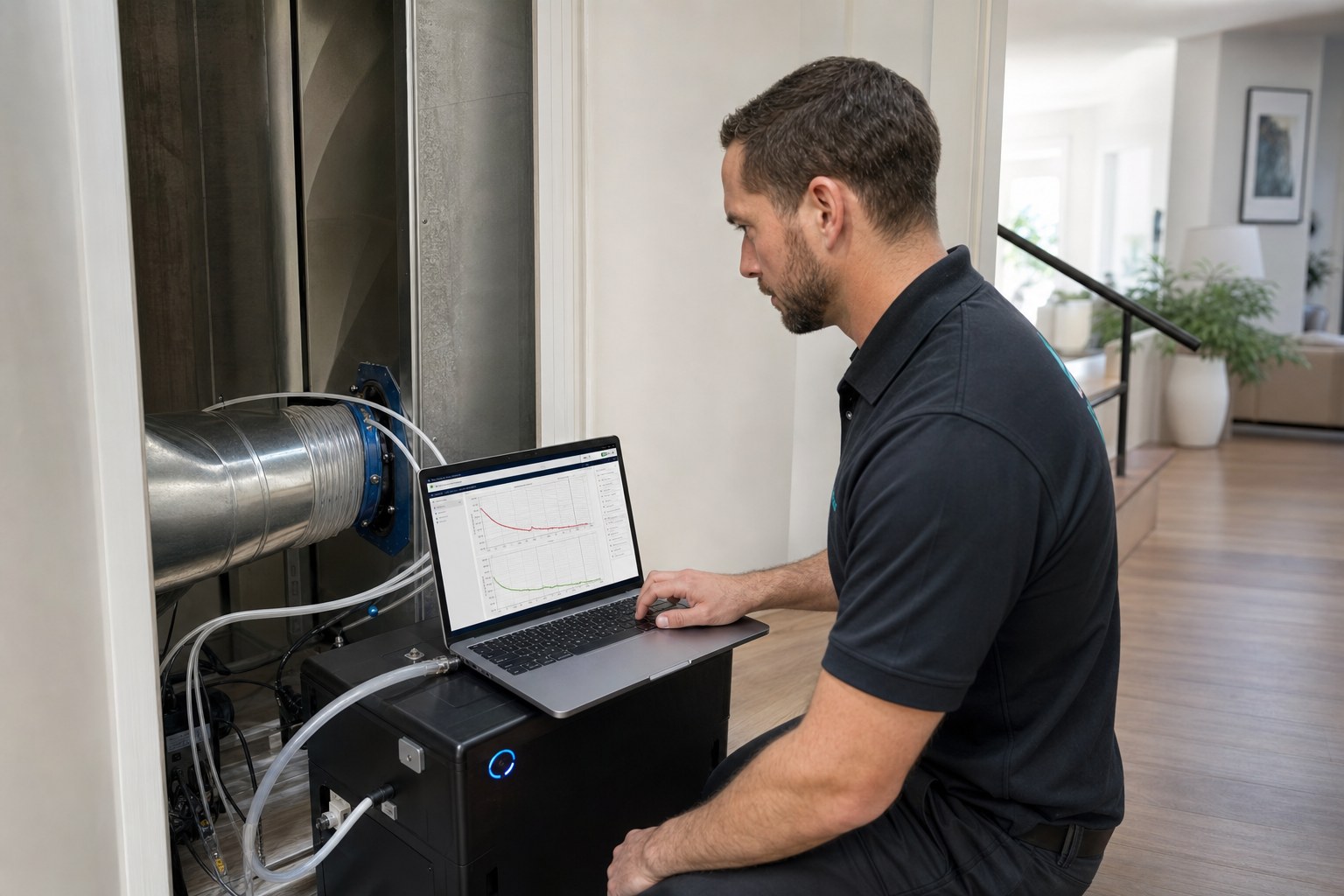
The home is then pressurized using the blower door equipment while the AeroBarrier sealant is atomized into the interior air. The sealant is water-based, low-VOC, and approved for use in occupied buildings. Particles travel through the pressurized envelope and accumulate at gap sites, sealing them progressively. The laptop monitoring station displays leakage rate in real time as the seal builds up.
A typical single-family home reaches target leakage rates in two to four hours. The process leaves no visible residue on finished surfaces when applied correctly at the pre-drywall stage. Your framing crew can return to work the same day.
Our new construction air sealing page has additional details on scheduling and site preparation requirements.
EVERGY Rebates and Energy Certifications for KC Builders
Kansas City builders who deliver verified air-tight homes have access to rebate programs through EVERGY, the primary utility serving the Kansas City metro. Green Seal Energy is EVERGY’s number one certified rebate partner, which means we can help your buyers access rebates for qualified air sealing work as part of a broader energy efficiency package.
For builders pursuing ENERGY STAR Certified Homes or DOE Zero Energy Ready Home certification, verified air leakage results are a required component of the certification package. AeroBarrier’s printed documentation meets the verification requirements for both programs.
Buyers in the Kansas City market are increasingly asking about energy costs before they sign contracts. A home with a verified low HERS score and documented air sealing work is a marketing asset. Several production builders in Overland Park and Lenexa have used their energy certifications as a differentiator in a competitive market.
Frequently Asked Questions
When in the construction timeline should we schedule AeroBarrier?
AeroBarrier is most effective after mechanical rough-in is complete and all penetrations are in place, but before drywall is hung. This typically falls between the framing inspection and the insulation inspection. Scheduling the process during this window gives you verified results before the envelope is closed. Green Seal Energy can coordinate with your project manager to slot the application into your schedule without causing delays.
Does AeroBarrier meet Kansas City building code for air sealing?
Yes. AeroBarrier is an ICC-approved air sealing method and meets or exceeds the air leakage requirements in the 2021 IRC for Climate Zone 4, which covers the Kansas City metro. The process produces a blower door test result that can be submitted directly to your building department or third-party HERS rater as documentation of compliance.
What happens if a home still fails the blower door test after AeroBarrier?
The AeroBarrier process is monitored in real time, so we do not leave a job until the target leakage rate is achieved. If site conditions prevent reaching target, our team documents exactly where residual leakage is occurring so your crew can address specific locations. This is rare but does occur on homes with atypical framing or large unaddressed penetrations. We communicate clearly throughout the process so there are no surprises.
Can AeroBarrier be used after drywall is installed?
AeroBarrier can be applied after drywall, but the process is less effective because many gap sites are no longer accessible to the pressurized air stream. The pre-drywall application is strongly preferred for new construction. For existing homes, Green Seal Energy uses other air sealing methods. See our AeroBarrier service page for more details on both applications.
Get Your Kansas City New Construction Project Code-Ready
Air sealing requirements in the Kansas City metro are tightening, and the builders who adapt early will avoid costly rework later. Whether you are building in Johnson County, Jackson County, or anywhere across the KC metro, Green Seal Energy can help you hit your HERS targets and document compliance before drywall goes up.
Call Green Seal Energy at (816) 200-0129 or schedule online to discuss your upcoming projects and get AeroBarrier on your construction timeline.