Every fall, Kansas City homeowners run through the standard HVAC prep list: replace the filter, check the thermostat batteries, schedule a furnace tune-up. Those steps matter. But there’s one item almost every checklist leaves out, and skipping it means your heating system can run perfectly and still waste hundreds of dollars before spring. HVAC efficiency in Kansas City comes down to more than equipment condition — it comes down to whether the conditioned air your furnace produces actually reaches the rooms you’re heating, or escapes into your attic and crawlspace before it gets there. Duct leakage testing is the step most homeowners never take, and this guide explains why it belongs on every fall HVAC checklist.
The Standard Fall HVAC Checklist (and What It Misses)
Here is what most professional HVAC tune-ups and DIY fall prep guides include:
- Replace the air filter with a clean MERV 8 or better
- Test and replace thermostat batteries
- Clean the area around the furnace and air handler
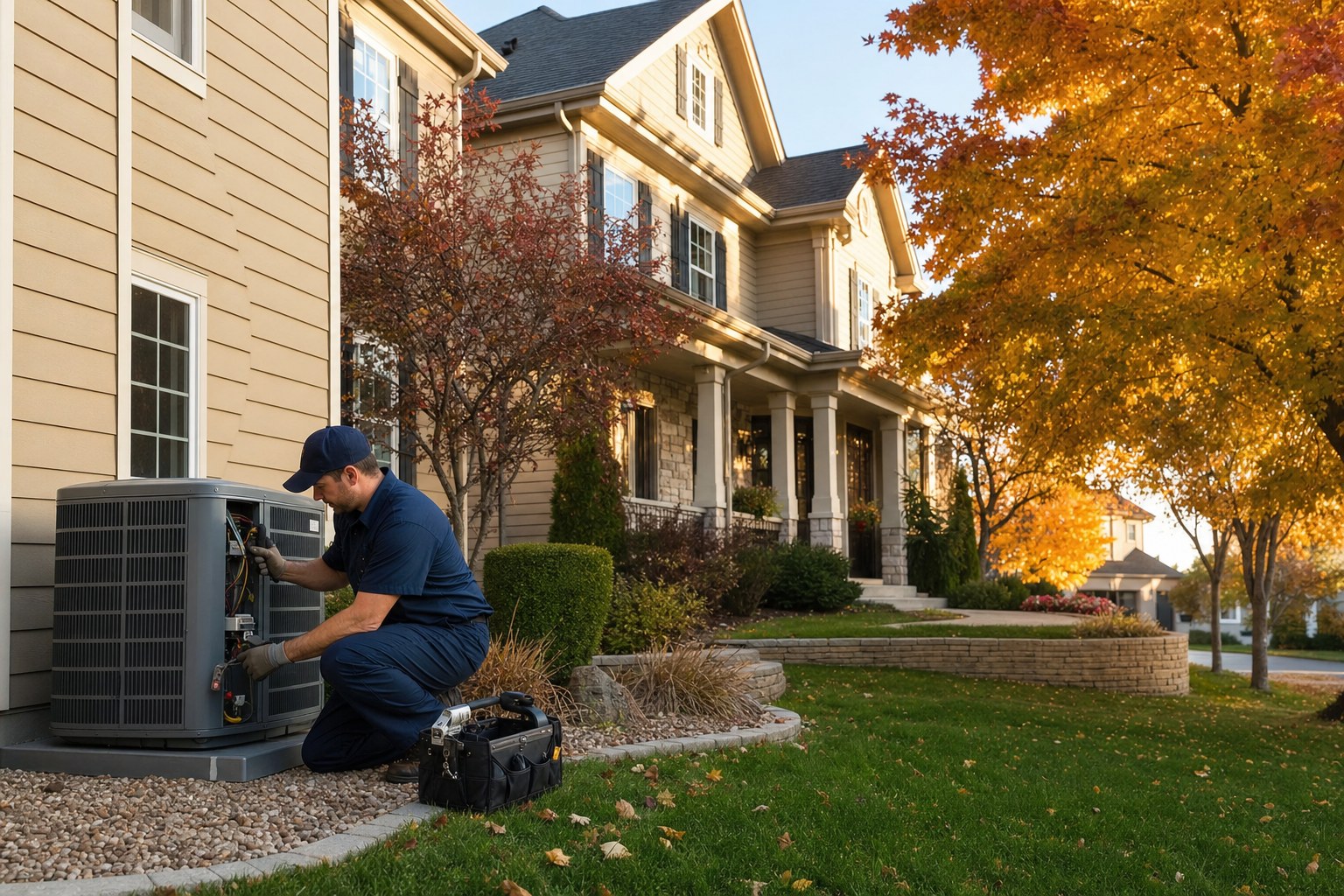
- Schedule a professional tune-up to check the heat exchanger, burners, flue, and igniter
- Check that vents are open and unobstructed in all rooms
- Test the carbon monoxide detector and smoke alarms
- Inspect weather stripping on doors and windows
All of that is worth doing. A tune-up catches mechanical issues that can cause breakdowns during the first cold snap, and filter changes protect the heat exchanger from restricted airflow.
What’s missing is any evaluation of the duct system — the network of supply and return lines that carries heat from your furnace to every room in the house. In Kansas City homes, those ducts are often in attics, crawlspaces, or interior walls, and they commonly lose 20 to 40 percent of conditioned air through leaks at joints and connections.
A furnace that’s running at 97 percent efficiency still delivers a costly result if 30 percent of the heat it produces escapes into unconditioned space before reaching a living area. That’s the gap no standard tune-up addresses.
What Duct Leakage Testing Actually Involves
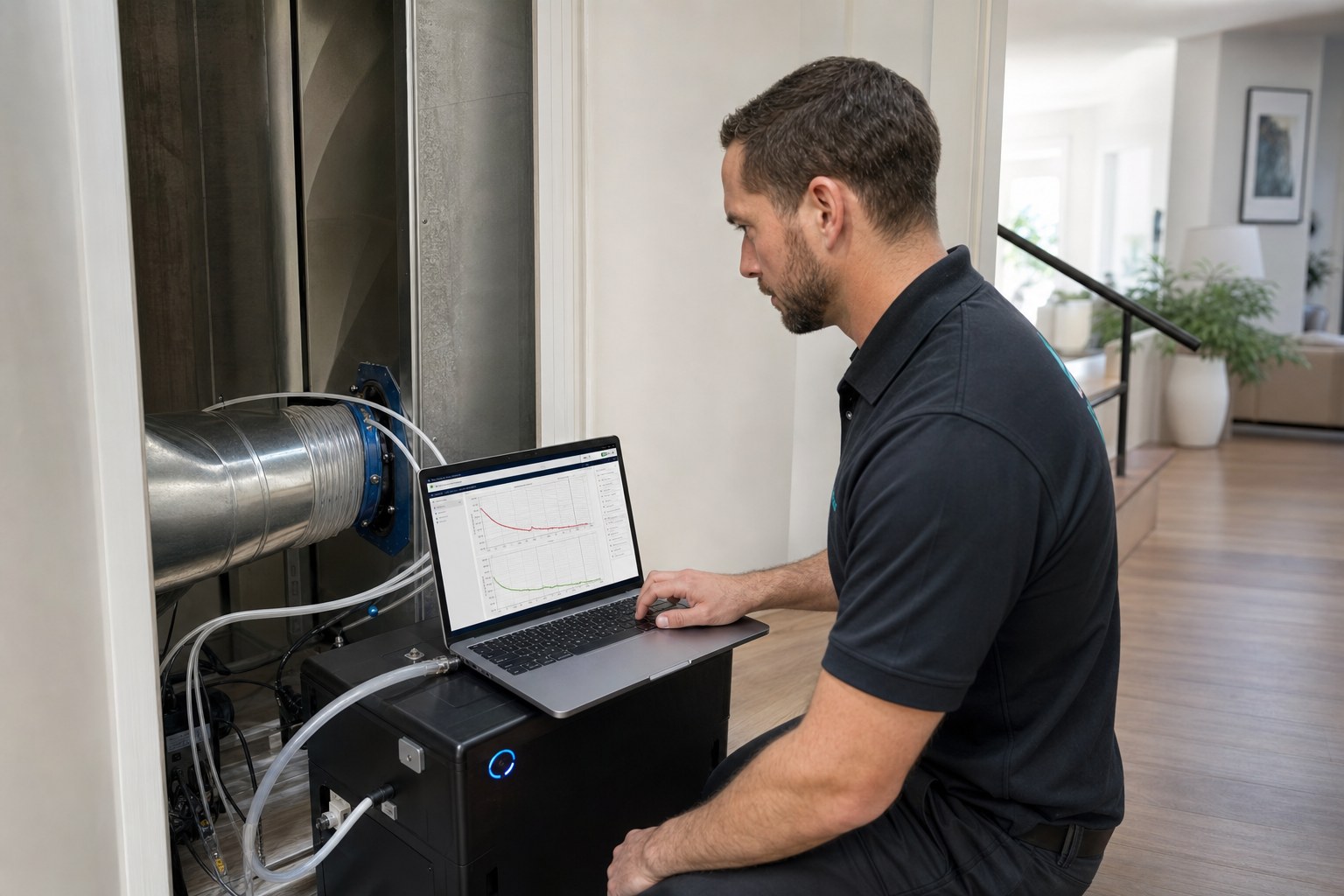
Duct leakage testing measures how much air escapes from your duct system under pressure, expressed as a percentage of the system’s total airflow capacity. The test involves temporarily blocking supply and return vents, pressurizing the system with a calibrated fan, and measuring the pressure decay rate.
The result tells you two things: your total duct leakage percentage, and whether leaks are primarily to conditioned space (less wasteful) or to unconditioned space like an attic or crawlspace (directly wasteful and a moisture risk).
According to the U.S. Department of Energy, duct leakage to outside conditioned space in typical American homes accounts for 20 to 30 percent of the energy used for heating and cooling. For a Kansas City home spending $200 per month on winter heating, that’s $40 to $60 per month — $200 to $300 over a heating season — disappearing through duct joints before it reaches a single room.
Testing takes less than an hour and gives you a specific number, not a guess. It’s the foundation of any honest HVAC efficiency recommendation.
What Happens If You Skip Duct Testing: A KC Winter Cost Comparison
To make the impact concrete, consider two Kansas City homes that are identical in size, insulation, and furnace efficiency, but with different duct conditions:
Home A — no duct leakage: $1,800 estimated annual heating bill
Home B — 30% duct leakage to unconditioned attic: Effective heating delivered to living space is only 70% of furnace output, meaning the furnace must run proportionally longer. Estimated annual heating bill: $2,400+
The $600 difference in that example is a conservative estimate. Homes with older duct systems, flex duct in attics, or metal ducts with deteriorated joint tape can lose even more. If you’ve been increasing your furnace’s output setting over the years and your home still feels cold in certain rooms, leaky supply ducts serving those rooms are a common cause.
Addressing duct leakage through Aeroseal duct sealing before a Kansas City winter can recover most of that loss. With EVERGY rebates, the net cost of Aeroseal sealing for a mid-size home can be in the $1,300 to $1,800 range, meaning it often pays back in two to three heating seasons.
How Duct Sealing Fits Into Fall HVAC Prep
Timing matters for duct sealing. Scheduling it in fall — before heating season — means you capture the efficiency benefit through the most expensive months of the HVAC year. Waiting until spring means you’ve already paid the penalty for one full heating season.
The Aeroseal process works in a few hours and doesn’t require your system to be down during cold weather. A technician seals the system while it’s not in heating mode, then verifies the result before leaving. You start using a tighter duct system from day one of heating season.
Our HVAC efficiency services include duct leakage testing as part of the initial diagnostic. We’ll tell you your current leakage rate before we recommend any work, so you can make a decision based on actual numbers rather than estimates.
For Kansas City homeowners in Overland Park, Olathe, Shawnee, Lee’s Summit, and surrounding suburbs, the scheduling window for fall projects fills earlier than most people expect. EVERGY rebate funding also has annual caps that close before the end of the year. Calling (816) 200-0129 in September or October is significantly better than waiting until November.
The Full Fall HVAC Checklist: The Version That Actually Works
Here’s the checklist that combines standard prep with the duct step most guides skip:
- Replace the air filter (MERV 8 or better for most homes)
- Test and replace thermostat batteries
- Schedule a professional furnace tune-up to inspect the heat exchanger, burners, flue, and igniter
- Test carbon monoxide detectors and smoke alarms
- Clear the area around the furnace and air handler
- Inspect weather stripping and door/window seals
- Schedule a duct leakage test. Get your actual leakage number. If it exceeds 15 percent of system airflow, you have a meaningful efficiency problem worth addressing before heating season starts.
- If leakage is high, schedule Aeroseal duct sealing and apply for the EVERGY rebate before funding closes for the year.
- Check that supply registers in all rooms are open and that furniture isn’t blocking return vents.
- If your home has ductwork in a crawlspace or uninsulated attic, consider duct insulation at the same time as sealing.
Step 7 is what separates homes that run efficiently all winter from homes that run their furnace constantly and still pay high bills. It costs nothing to measure and often reveals a problem worth thousands of dollars in savings once fixed.
GSE’s Fall Scheduling Window and EVERGY Rebates
Green Seal Energy is EVERGY’s number one certified rebate partner in the Kansas City metro, which means we handle the rebate documentation that qualifies your duct sealing project for utility incentives. EVERGY rebates for duct sealing vary based on verified leakage reduction, with potential offsets of up to $300 for qualifying projects.
The rebate program operates on annual funding. Projects completed and submitted earlier in the fall have the best chance of processing before year-end funding caps are reached. We’re also the only Elite Aeroseal dealer in Kansas City, which means certified technicians and current equipment — not a contractor who does Aeroseal twice a month as a sideline service.
To get on the fall schedule and lock in your EVERGY rebate eligibility, call Green Seal Energy at (816) 200-0129 or schedule online. We serve Overland Park, Olathe, Shawnee, Lenexa, Lee’s Summit, Blue Springs, Independence, Liberty, and the full Kansas City metro.
Frequently Asked Questions About Fall HVAC Prep in Kansas City
Do I need a duct leakage test if my HVAC system is only a few years old?
Newer systems can still have leaky ducts. The ductwork and the HVAC equipment are often installed separately, and duct quality depends heavily on the original installer’s workmanship. Some newer homes in the Kansas City suburbs have been tested and found with 25 percent or higher leakage rates despite having equipment installed within the last five years. Testing takes the guesswork out of it.
How long does Aeroseal duct sealing take?
For a typical Kansas City home, the Aeroseal process takes three to five hours from setup to final verification. The system needs to be off heating or cooling mode during the process, which is easy to manage in fall before temperatures drop significantly. You’ll get a printed before-and-after leakage report on the same day.
Can I just use mastic or foil tape on my own ducts instead of Aeroseal?
Accessible joints — visible seams in your basement or utility room — can be sealed with mastic or foil-backed tape. But most of the leakage in a typical duct system is at internal joints buried in walls, floors, or above ceilings where you can’t reach them. Aeroseal seals those inaccessible locations from the inside by traveling with the airstream to reach every gap. DIY surface sealing on accessible joints is worth doing as a supplement, but it rarely addresses more than a fraction of total leakage.
What is the EVERGY rebate deadline for duct sealing?
EVERGY’s rebate programs operate on a fiscal year with annual funding caps. There is no fixed calendar deadline, but once annual funding is exhausted, new applications wait until the following year’s funding cycle. Scheduling in September or October historically gives the best chance of processing before the program closes for the year. Call us at (816) 200-0129 and we’ll check current rebate status when you schedule.